Temple of Eudaimonia™
The Eudaimon Warrior: The Architecture of the Inner Battle
“Spartan” today is a word we use to mean simple. In truth, it meant brutal. To be born in ancient Sparta was to enter a city where strength was duty, not decoration.
Infants were carried before the elders; if found frail or deformed, they were left exposed on the slopes of Mount Taygetus. The city would not spend its strength on those it believed could not endure.
At seven, boys entered the agōgē. Mothers released them, and the state claimed them. They slept on reeds, wore a single cloak through summer heat and winter frost, and were kept constantly hungry. Plutarch tells of a boy who hid a fox beneath his tunic, letting it claw his belly to death rather than confess his theft. Hardship was not an accident; it was an architecture. Pain instructed, and the body became the absolute servant of the will. Cruel? Undoubtedly. But it was a cruelty designed to forge an unbreakable line. And when Xerxes crossed into Greece with his vast Persian army, it was three hundred Spartans who stood at Thermopylae, outnumbered, but unbroken.
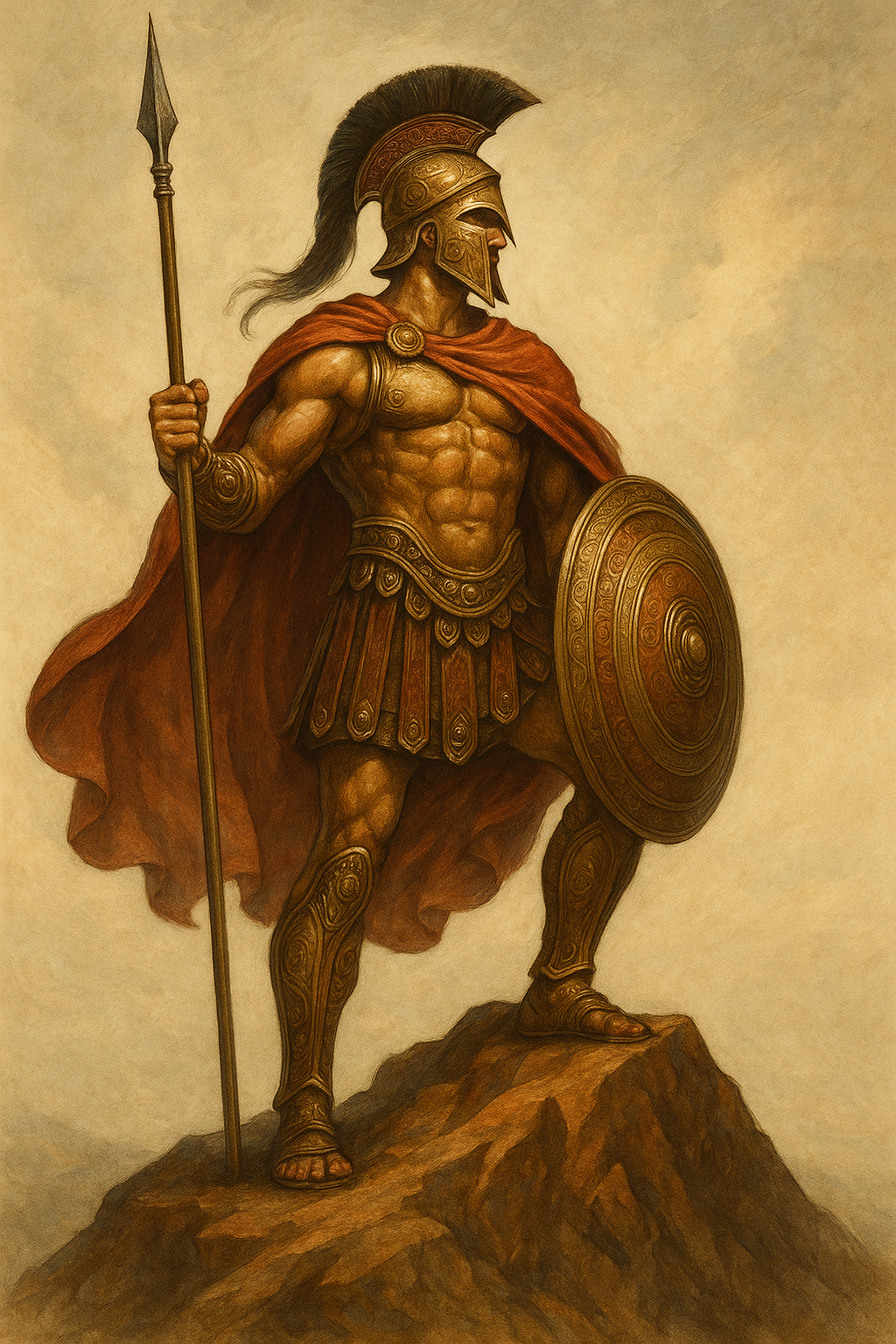
In ancient Greek philosophy, eudaimonia refers to the highest human good: a flourishing life lived with meaning, virtue, and alignment with one’s true potential. The image of the classical warrior encapsulates this ideal not through brute force or conquest, but through absolute discipline, integrity, and alignment of purpose.
A Spartan is not merely a fighter; he is a symbol of aretē: the Greek notion of excellence in all aspects of life. His existence is guided by courage, wisdom, self-mastery, and justice, the same four cardinal virtues that underpin the eudaimonic life described by the Stoics.
We no longer fight with bronze in narrow mountain passes, yet the human mind remains a daily battlefield against distraction, comfort, and fear. If we translate the warrior's physical panoply (his armor and weapons) into the architecture of the soul, we find a perfect blueprint for modern flourishing.
Let us examine this archetype, piece by piece:
1. The Spear (Telos: Direction and Focus)
The spear represents intention, focus, and direct action. It points outward, perfectly aligned with the warrior’s gaze. It symbolizes the ability to commit to a single path and move forward with clarity, cutting through the noise and hesitation of the modern world. It is not an instrument of destruction, but the physical expression of a will aligned with its ultimate aim (telos).
Symbolic message: Eudaimonia demands conscious, skillful action. You must know your target before you throw your weight behind the strike.
2. The Shield (Oikeiōsis: Boundaries and Duty)
The heavy round shield (aspis) is the symbol of inner integrity and civic duty. In the Spartan phalanx, a warrior’s shield did not protect his own body; it covered the unshielded right side of the man standing next to him. It stands between the self and chaos, not to shut out the world, but to defend what is sacred.
Symbolic message: To live eudaimonically is to protect what is right, not just what is yours. True strength is the margin that shelters the people around you.
3. The Breastplate (Askēsis: Self-Mastery and Habit)
The bronze armor encasing the chest symbolizes daily discipline and habitual virtue (askēsis). It is not a rigid wall hidden behind, but a second skin forged through repetition. It reflects the ability to endure difficulty while keeping the vital organs (the heart and lungs) protected from the immediate blows of fortune.
Symbolic message: Resilience is built through repetition. Virtue is what remains when the body is under stress.
4. The Helmet (Hegemonikon: Reason and Sovereignty)
The helmet guards the head: the seat of reason, perception, and judgment. To the Stoics, this ruling center (the hegemonikon) must be defended above all else. The helmet limits peripheral distraction, forcing the warrior to look only at what is directly in front of him.
Symbolic message: A Eudaimon must protect the mind. From clear perception flows all virtue and choice.
5. The Body (The Grounded Vessel)
The poised, conditioned body beneath the armor represents potential realized in the physical world. It is shaped by effort, self-care, and action. This musculature reflects power bound by responsibility; strength developed not for domination, but for service and endurance.
Symbolic message: You cannot separate a flourishing mind from the living, breathing vessel that acts in the physical world.
6. The Stance (Prosochē: Presence and Readiness)
The warrior stands grounded, one foot forward, gaze locked ahead. This pose signifies prosochē: vigilant, present-moment awareness. It mirrors the inner state of someone who is never passive or merely reactive, but actively engaging with reality as it is.
Symbolic message: To be Eudaimon is to live deliberately, anchored completely in the present, while holding your eyes on the horizon.
The Warrior as a Mirror for the Inner Life
The Eudaimon Warrior is not a glorification of violence. It is a visual metaphor for living with clarity in a world that constantly invites us to soften, surrender, or drift.
Whether in antiquity or today, the warrior represents the inner battle for a meaningful life: a battle won not through dominance over others, but through absolute dedication to one’s higher self.
Where others flee hardship, the Eudaimon stands.
Where others crave applause, the Eudaimon seeks alignment.
Where others drift, the Eudaimon chooses.
Through spear, shield, and armor, the classical warrior remains the ultimate image of the inner posture of a flourishing human being.