Temple of Eudaimonia™
Lessons from the Parthenon
When we speak of a temple, most imagine marble already standing: gleaming columns, carved capitals, balance and symmetry. Few imagine the stonecutters. Few imagine the years of quarrying, the backs bent under blocks, the crude scaffolding of ropes and pulleys.
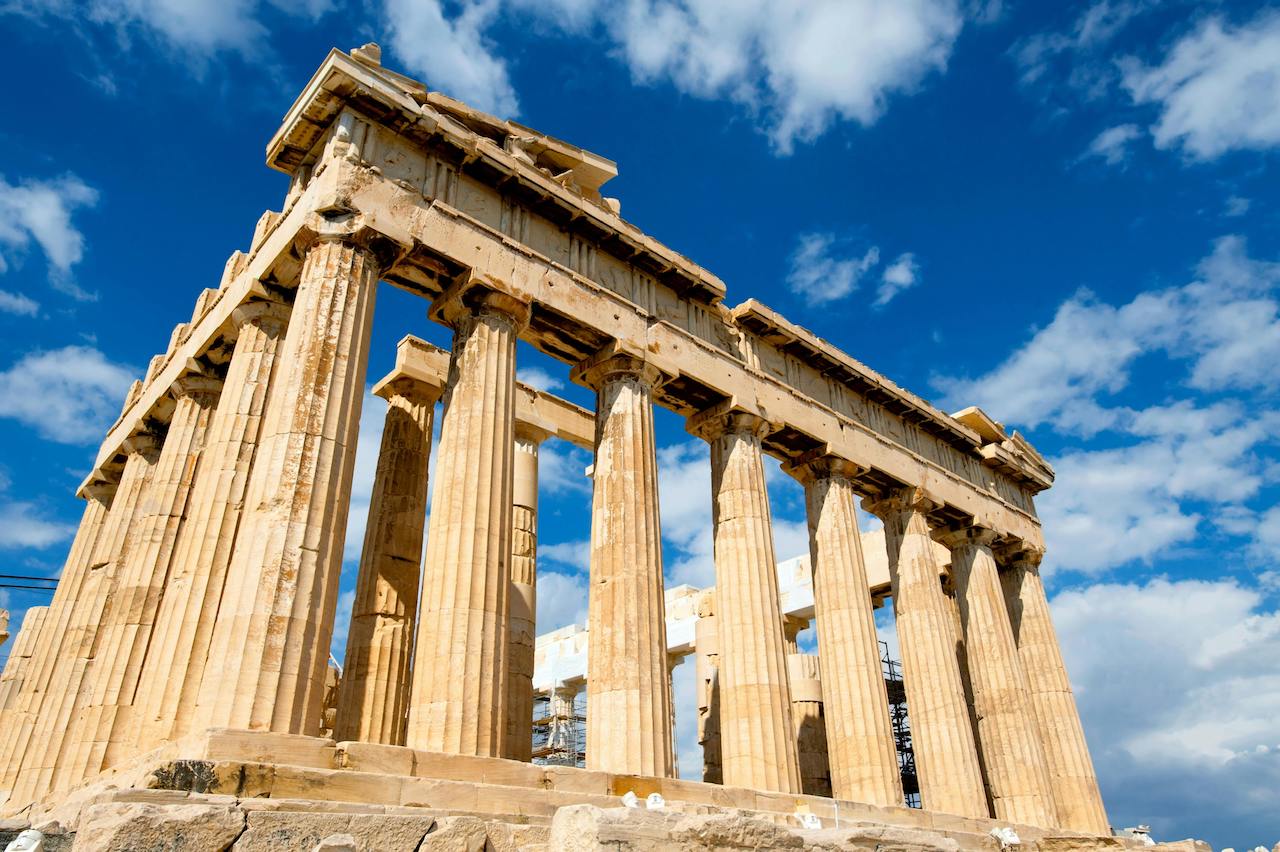
The Parthenon in Athens did not appear like Athena from the head of Zeus. It rose from dust, one block at a time. The stone was quarried ten miles away at Mount Pentelikon. Men cut blocks with bronze chisels and wooden wedges soaked in water, waiting patiently for the swelling of the wood to split the rock. Each block weighed tons. They were dragged on sledges, hauled by oxen, and inched down the slope to the city. There was no magic in it. Only patience, friction, and weight.
When the stones finally reached the Acropolis, they were not simply stacked. The master builders of Athens understood a fundamental truth that modern minds often forget: human perception is flawed.
The architects knew that if they built a perfectly straight column, the bright Athenian sky would create an optical illusion, making it look pinched in the middle. If they laid a perfectly flat floor, the immense weight of the roof would make the floor appear to sag. To create a building that looked perfectly straight, they had to build it curved. The floor of the Parthenon bows slightly upward in the center. Every column swells subtly in the middle (a technique called entasis) and leans imperceptibly inward. It is a masterpiece of correction. The builders did not trust the raw, unedited eye; they compensated for human distortion to achieve true alignment.
Beneath the surface lay another secret. The Greeks did not use mortar, which dries rigid and shatters under stress. Instead, they carved hidden grooves into the meeting faces of the massive blocks. Into these invisible cavities they dropped iron clamps and poured molten lead over them. The iron gave the structure immense tensile strength, while the soft lead prevented rust and acted as an internal shock absorber. When earthquakes shook Athens, the Parthenon did not shatter. It flexed. What kept the temple standing was not the polished marble everyone could see, but the resilient, invisible bonds hidden entirely in the dark.
Scaffolding surrounded the rising walls for decades. Teams of men coordinated each pull of the counterweights, knowing a single hurried misstep could shatter months of work. The Parthenon consumed fifteen years; the great Temple of Artemis took more than a century. Whole generations began work they knew they would never see finished.
They worked with such exactness because they knew the point was not speed, but endurance. Temples were meant to outlast the men who built them. The patience of those masons is still visible today, two thousand years later, in ruins that remain more dignified than most modern structures standing whole.
So too with a human life. You do not quarry and raise your own character in a weekend. You quarry daily: strength, judgment, sufficiency.
Like the architects adjusting for optical illusions, you must constantly correct your own perception, knowing that fear, anger, and ego will always distort reality if left unchecked. Like the iron set in lead, you must build invisible integrity and resilience on the inside, so that when the ground shakes, you can absorb the shock without fracturing. You cut the blocks, you haul them, and you shape them to fit with care. The most important stones are the habits nobody sees, the disciplines practiced in silence.
The Stoics understood this architecture of the soul. Marcus Aurelius spoke of life as a citadel. Epictetus told his students: “No man can build a great work in a day. But each day, if he lays a little stone, soon he will have built something great.”
This is why the temple endures as a metaphor. It is not a romantic daydream. It is brutal. You cut, you lift, you sweat. Your life will collapse if you expect grandeur without the quarrying. And yet it is profoundly delicate. The angle of a column, the fraction of a groove, the invisible balance of forces inside the stone.
To live well is to build like this. Patiently. Brutally. Delicately. With the humility of a mason who knows the stones he sets today may not crown until long after he is gone.